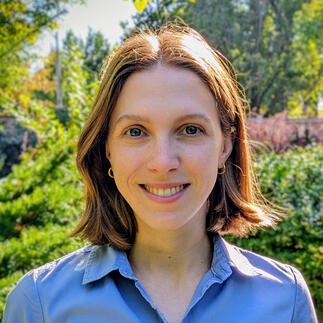
Natalia Ladyka-Wojcik, PhD
Professeure
Université du Québec en Outaouais
À propos de moi
Je m’appelle Natalia Ladyka-Wojcik (elle) et je suis professeure adjointe au Département de psychoéducation et de psychologie de l’Université du Québec en Outaouais (UQO). Mes recherches font appel à des méthodes comportementales, computationnelles et de neuroimagerie afin de mieux comprendre les mécanismes cognitifs et neuronaux qui sous-tendent les interactions entre ce que nous voyons et ce dont nous nous souvenons, ainsi que la façon dont ces interactions évoluent avec l’âge.J’ai réalisé mon doctorat en psychologie sous la direction de la Dre Morgan Barense à l’Université de Toronto, puis un stage postdoctoral auprès de la Dre Maureen Ritchey au Boston College. Plus récemment, j’ai été chercheuse postdoctorale financée par le CRSNG dans le laboratoire de la Dre Jennifer D. Ryan au Rotman Research Institute de Baycrest Health Sciences.Je travaille actuellement à la mise sur pied de mon nouveau laboratoire, le Laboratoire de la mémoire visuelle et du vieillissement, à l’UQO. Restez à l’affût des prochaines nouvelles concernant nos recherches, les nouveaux membres du laboratoire et bien plus encore!

Natalia Ladyka-Wojcik, PhD
Professeure
Université du Québec en Outaouais
Nos recherches
Comment la perception visuelle et la mémoire interagissent-elles pour soutenir une cognition flexible?
Notre expérience du monde repose sur des interactions continues entre ce que nous voyons et ce dont nous nous souvenons. Mes recherches examinent la façon dont les régions cérébrales impliquées dans la perception et la mémoire communiquent entre elles afin de construire des représentations cohérentes de notre environnement, ainsi que la manière dont ces interactions nous permettent de mobiliser de façon flexible différentes dimensions de nos expériences passées. En m’appuyant notamment sur la neuroimagerie fonctionnelle, les analyses de connectivité effective et l’EEG, j’étudie comment l’information est représentée et échangée entre les systèmes perceptifs et mnésiques à mesure que nos objectifs et nos expériences évoluent.
Comment le vieillissement modifie-t-il nos représentations des expériences visuelles et spatiales?
Le vieillissement en santé s’accompagne de changements non seulement dans la quantité d’informations dont nous nous souvenons, mais aussi dans la précision et l’organisation de nos souvenirs. Mes recherches examinent comment le vieillissement affecte les représentations des objets visuels, des scènes et des relations spatiales, en mettant particulièrement l’accent sur les lobes temporaux médians du cerveau. Ces travaux cherchent à déterminer quels aspects de l’expérience demeurent stables au cours de la vie, lesquels deviennent moins précis ou moins différenciés, et comment les changements dans la représentation de l’information spatiale peuvent influencer les comportements guidés par la mémoire.
Comment la mémoire nous permet-elle de prédire ce que nous verrons ensuite?
La mémoire ne sert pas uniquement à préserver le passé : elle nous permet aussi d’anticiper ce qui est susceptible de se produire ensuite. Une grande partie de mes recherches actuelles vise à comprendre comment les souvenirs de nos expériences visuelles et spatiales génèrent des prédictions qui orientent la perception et l’exploration visuelle en temps réel. En combinant l’oculométrie à la neuroimagerie et à l’électrophysiologie, ces travaux examinent comment émergent les prédictions fondées sur la mémoire, comment nous réagissons lorsque ces prédictions sont violées et comment nos souvenirs sont mis à jour afin de soutenir de futures prédictions. Un objectif important de cette recherche est de comprendre comment ces processus évoluent avec le vieillissement.

Natalia Ladyka-Wojcik, PhD
Professeure
Université du Québec en Outaouais
Publications
Where we look, what we know: how hippocampal predictions shape, and are shaped by, eye movements
Ladyka-Wojcik, N., Flick, G., Liu, Z-X., & Ryan, J.D. (2026). Where we look, what we know: how hippocampal predictions shape, and are shaped by, eye movements . Philosophical Transactions of the Royal Society B, 381, 1954, 20250248. https://royalsocietypublishing.org/rstb/article/381/1954/20250248/482494/Where-we-look-what-we-know-how-hippocampal
Novelty discrimination of configural objects in the perirhinal and anterolateral entorhinal cortices is impacted by aging
Ladyka-Wojcik, N., Liang, J.Y, Allen, S.D., Ryan, J.D., Olsen, R.K., & Barense, M.D. (2026). Novelty discrimination of configural objects in the perirhinal and anterolateral entorhinal cortices is impacted by aging. Journal of Neuroscience, 46, 19, e1462252026. https://www.jneurosci.org/content/46/19/e1462252026
Effective connectivity between the medial temporal lobes and early visual cortex modulated by unrestricted viewing predicts memory retrieval and gaze reinstatement
Ladyka‐Wojcik, N.*, Liu, Z.-X.*, & Ryan, J.D. (2025). Effective connectivity between the medial temporal lobes and early visual cortex modulated by unrestricted viewing predicts memory retrieval and gaze reinstatement. Imaging Neuroscience, 3, IMAG.a.133. https://doi.org/10.1162/IMAG.a.133
*co-first authorship
Neural signatures of recollection are sensitive to memory quality and specific event features
Ladyka‐Wojcik, N.*, Schmidt, H*, Cooper, R.A., & Ritchey, M. (2025). Neural signatures of recollection are sensitive to memory quality and specific event features. Journal of Cognitive Neuroscience, 37(10), 1757-1773. https://doi.org/10.1162/jocna02335
*co-first authorship
Surveying the neuroimager's connectivity toolbox: Comment on "Connectivity analyses for task-based fMRI" by Huang, De Brigard, Cabeza, & Davis
Ladyka‐Wojcik, N. & Ritchey, M. (2024). Surveying the neuroimager's connectivity toolbox: Comment on "Connectivity analyses for task-based fMRI" by Huang, De Brigard, Cabeza, & Davis. Physics of Life Reviews, 51, 101-103. https://doi.org/10.1016/j.plrev.2024.09.012
Experience transforms crossmodal object representations in the anterior temporal lobes
Li, A. Y., Ladyka‐Wojcik, N., Qazilbash, H., Golestani, A., Walther, D. B., Martin, C. B., & Barense, M. D. (2024). Experience transforms crossmodal object representations in the anterior temporal lobes. eLife, 13, e83382. https://doi.org/10.7554/eLife.83382
Impaired perceptual discrimination of complex objects in older adults at risk for dementia
Jiang, L., Robin, J., Shing, N., Mazloum‐Farzaghi, N., Ladyka‐Wojcik, N., Balakumar, N., ... & Olsen, R. K. (2024). Impaired perceptual discrimination of complex objects in older adults at risk for dementia. Hippocampus, 34(4), 197-203. https://doi.org/10.1002/hipo.23598
Sleep differentially and profoundly impairs recall memory in a patient with fornix damage
Matorina, N., Tseng, J., Ladyka-Wojcik, N., Olsen, R. K., Mabbott, D. J., & Barense M. D. (2023). Recollection and prior knowledge recruit the left angular gyrus during recognition. Journal of Cognitive Neuroscience, 35(10), 1635-1655. https://doi.org/10.1162/jocna02038
Recollection and prior knowledge recruit the left angular gyrus during recognition
Bellana, B., Ladyka-Wojcik, N., Lahan, S., Moscovitch, M., & Grady, C. L. (2023). Recollection and prior knowledge recruit the left angular gyrus during recognition. Brain Structure and Function, 228, 197-217. https://doi.org/10.1007/s00429-022-02597-5
Unrestricted eye movements strengthen causal connectivity from hippocampal to oculomotor regions during scene construction
Ladyka-Wojcik, N.*, Liu, Z.-X.*, & Ryan, J. D. (2022). Unrestricted eye movements strengthen causal connectivity from hippocampal to oculomotor regions during scene construction. NeuroImage, 260, 119497. https://doi.org/10.1016/j.neuroimage.2022.119497
*co-first authorship
The influence of cerebrovascular pathology on cluster analysis of neuropsychological scores in patients with mild cognitive impairment
Romero, K.*, Ladyka-Wojcik, N.*, Heir, A., Bellana, B., Leach, L., & Proulx, G. B. (2022). The association between visual discrimination and cognitive decline prior to clinical diagnosis. Archives of Clinical Neuropsychology 37(7), 1480-1492. https://doi.org/10.1093/arclin/acac043
*co-first authorship
Flexible use of spatial frames of reference for object-location memory in older adults
Ladyka-Wojcik, N., Olsen, R.K., Ryan, J.D., & Barense, M.D. (2021). Flexible Use of Spatial Frames of Reference for Object-Location Memory in Older Adults. Brain Sciences, 11(11), 1542. https://doi.org/10.3390/brainsci11111542
The influence of prior knowledge on the formation of detailed and durable memories
Bellana, B., Mansour, R., Ladyka-Wojcik, N., Grady, C. L., & Moscovitch, M. (2021). The influence of prior knowledge on the formation of detailed and durable memories. Journal of Memory and Language, 121, 104264. https://doi.org/10.1016/j.jml.2021.104264
Reframing spatial frames of reference: What can aging tell us about egocentric and allocentric navigation?
Ladyka‐Wojcik, N., & Barense, M. D. (2021). Reframing spatial frames of reference: What can aging tell us about egocentric and allocentric navigation?. Wiley Interdisciplinary Reviews: Cognitive Science, e1549. https://doi.org/10.1002/wcs.1549
Giving evolution its due in memory systems research
Bouffard, N.R.*, Ladyka-Wojcik, N.*, Barense, M.D., Giving evolution its due in memory systems research (2019). [Invited review of the book Evolution of Memory Systems, by Murray, E., Wise, S., & Graham, K.] Quarterly Journal of Experimental Psychology, 72(5), 1282-1283S, https://doi.org/10.1177/1747021819832227
*co-first authorship

Natalia Ladyka-Wojcik, PhD
Professeure
Université du Québec en Outaouais
Enseignement
Vous cherchez du matériel à utiliser dans vos cours? Si vous souhaitez utiliser ou adapter certains de mes documents pédagogiques, figures ou autres ressources dans le cadre de vos propres cours, n’hésitez pas à me contacter à natalia.ladyka-wojcik [ à ] uqo.ca. Je suis toujours heureuse de partager mon matériel lorsque cela est possible.
Responsable de cours
PSY2403 Psychologie du vieillissement
Département de psychoéducation et de psychologie, Université du Québec en Outaouais
Automne 2026PSY201 Introduction to Statistics
Department of Psychology, University of Toronto
Été 2022PSY493 Cognitive Neuroscience
Department of Psychology, University of Toronto
Automne 2021
Assistante d'enseignement
(University of Toronto / Université de Toronto)
PSY100 Introduction to Psychology
Automne 2021, Hiver 2023, Automne 2023PSY202 Introduction to Statistics II
Conférences invitées: Repeated-Measures analysis of variance (ANOVA)
Hiver 2019, Été 2019, Été 2020, Été 2021PSY240 Introduction to Abnormal Psychology
Conférences invitées: Dissociative and Somatic Symptom Disorders
Automne 2019, Hiver 2021PSY260 Learning & Plasticity
Automne 2021, Automne 2023PSY270 Introduction to Cognitive Psychology
Conférences invitées: (1) Visual Imagery, (2) Everyday Memory and Memory Mistakes
Automne 2018, Hiver 2021, Hiver 2023, Été 2023PSY305 The Treatment of Psychological Data
Conférences invitées: Panel host on graduate student life and research
Hiver 2022PSY372 Human Memory
Conférences invitées: (1) Memory Across the Lifespan, (2) Introduction to Scientific Writing
Hiver 2020, Automne 2020, Automne 2022